
Call us now :08045804297
 Send Inquiry
 Send Inquiry
Digital PH Meter
Price 8500 INR/ Piece
MOQ : 10 Pieces
Digital PH Meter Specification
- Temperature
- 0°C to 50°C
- Operating Voltage
- 9V
- Response Time
- Less than 30 seconds
- Equipment Type
- Digital PH Meter
- Humidity
- 0-80% RH (non-condensing)
- Test Range
- 0-14 pH
- Power Supply
- 9V DC Battery
- Display Type
- LCD Display
- Interface Type
- Electrode with BNC Connector
- Application
- Laboratory/Industrial/Field Testing
- Features
- Portable, Fast Response, Easy Calibration, Lightweight
- Accuracy
- ±0.1 pH
- Number of Specimens
- Single
- Resolution
- 0.01 pH
- Mounting Type
- Handheld
- Specimen Size
- Immersible Electrode
- Measuring Range
- 0-14 pH
- Automation Grade
- Manual
- Usage
- Measuring pH Value of Solutions
- Machine Weight
- 200 g (approx)
- Control Mode
- Manual
- Storage Temperature
- -10°C to 60°C
- Included Accessories
- Protective cap, Calibration screwdriver, Instruction manual
- Item Code
- DPM-001
- Protection Class
- IP54
- Dimensions
- approx 155 x 29 x 16 mm
- Calibration
- Manual single or two-point
- Battery Life
- Approx. 700 hours continuous use
- Electrode Type
- Combined Glass Electrode
Digital PH Meter Trade Information
- Minimum Order Quantity
- 10 Pieces
- Supply Ability
- 1 Piece Per Day
- Delivery Time
- 10-15 Days
About Digital PH Meter
Backed by a team of diligent professionals, we are actively engaged in supplying the premium grade Digital PH Meter. This device is used to measure the hydrogen ion activity in solution. The device consists of a voltmeter attached to an electrode that is sensitive to pH of a solution. Digital PH Meter is extensively used in laboratories and various industries to measure the pH value of a solution. Due to its precision design and reliable performance, we are seeing a huge demand for the device in the marketplace.
Specification
| Minimum Order Quantity | 1 Unit |
| Calibration Points | 2 points |
| Brand | Krishna Scientific Suppliers |
| Type | Table-Top |
| Display Type | 3 Digit LED display,16 x 2 alpha numeric LCD display |
| pH Range | 0 to 14 pH |
| Voltage | 220 V |
| Dimensions | 210 mm x 205 mm x 65 mm |
| Temperature Accuracy | +/-1 Deg C |
| Mv Accuracy | +/- 1mV |
| pH Resolution | +/-0.01 pH |
| pH Accuracy | +/- 0.01 pH |
| mV Range | 0 to +1999 mV |
| Temperature Range | 0 to 100 Deg C |
| Frequency | 50/60 Hz |
High Precision and Fast Response
Achieve rapid and accurate pH measurements with a resolution of 0.01 pH and an impressive accuracy of 0.1 pH. The digital PH meter utilizes a combined glass electrode and delivers results in under 30 seconds, making it ideal for immediate analysis in various settings such as laboratories, industrial sites, and fieldwork.
Designed for Portability and Ease of Use
With its lightweight, compact structure and handheld design, this meter travels easily between locations. Its protected under IP54 standards, ensuring durability against dust and splashing water. The included accessories and user-friendly interface further simplify day-to-day operation and calibration.
Manual Calibration for Reliable Results
Manual single or two-point calibration empowers users to maintain precision over time. Use the provided calibration screwdriver for straightforward adjustments, ensuring the device remains dependable in environments requiring high levels of accuracy and performance.
FAQs of Digital PH Meter:
Q: How do I calibrate the Digital PH Meter DPM-001?
A: Calibrating the DPM-001 involves using the included calibration screwdriver and your reference buffer solutions. You can choose between manual single-point or two-point calibration following the steps outlined in the instruction manual. Adjust the meter as needed to match the known pH values, ensuring continued measurement accuracy.Q: What applications is this PH meter suitable for?
A: This digital PH meter is ideal for laboratory experiments, industrial process monitoring, and field testing. Its portable and robust design allows for use across varied environments, whether you are testing water quality, soil analysis, or chemical solutions.Q: When should I replace the battery and what type does it use?
A: The meter operates with a 9V DC battery and provides about 700 hours of continuous use. Replace the battery when the LCD display dims or the device does not power on. Always use a standard 9V battery for reliable performance.Q: Where should I store the PH meter when not in use?
A: Store the meter at temperatures between -10C and 60C, and keep humidity below 80% RH (non-condensing). Always place the protective cap over the electrode to maintain its condition and prolong device lifespan.Q: What benefits does the combined glass electrode provide?
A: A combined glass electrode simplifies setup by integrating the reference and measuring components. This design improves reliability, ensures immersion suitability, and facilitates fast pH readings with high accuracy, making the meter practical and efficient.Q: How do I use the meter to measure pH?
A: To measure pH, immerse the glass electrode into your solution, power on the device, and wait for the LCD reading to stabilize (typically in less than 30 seconds). The meters ergonomic design and fast response make routine testing straightforward.Q: What environmental conditions should be maintained during use?
A: Operate the meter within 0C to 50C and 080% RH (non-condensing). The IP54 protection class ensures resilience to dust and minor water splashes, providing stable performance in most laboratory, industrial, and field environments.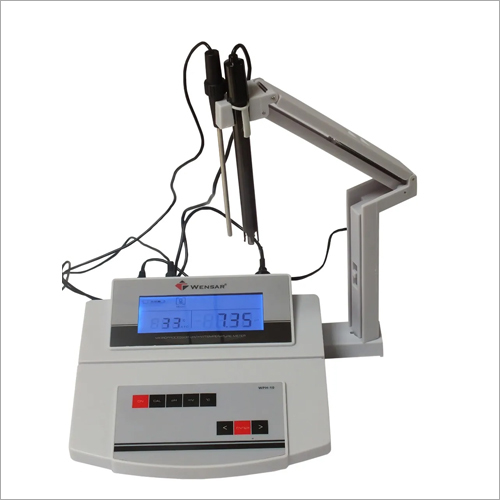
Tell us about your requirement

Price:
Quantity
Select Unit
- 50
- 100
- 200
- 250
- 500
- 1000+
Additional detail
Mobile number
Email


 Send Inquiry
Our Products
- Laboratory Autoclave
- Laboratory Dehumidifier
- Hot Plate
- Laboratory Fermenter
- Media Tank
- Laminar Air Flow
- Laboratory Shaker
- Laboratory Microscope
- Steam Sterilizer
- Centrifuge Machine
- Colony Counter
- Distilled Water Still
- Hot Air Oven
- Industrial Bioreactors
- Moisture Analyzer
- PH Meter
- Ribbon Blender
- Tray Dryer
- Granules Mixing Machine
- Industrial Autoclaves
- Industrial Fermenter
- Laboratory Equipment
- Laboratory Steam Sterilizer
- Plant Growth Chamber
- Ready Stocks Available
- Water Bath

No. 61, Kamatchi Nagar, Madhanandhapuram,Chennai - 600125, Tamil Nadu, India

Mr M Krishna Moorthy
(Proprietor)
Mobile :08045804297
 Send Inquiry
 Send SMS
Developed and Managed by Infocom Network Private Limited.
